Proof that your book is, well, yours.
A Provenance Report is behavioral evidence that a human wrote your manuscript — a lifeline to agents and publishers in a world clouded by AI doubt.
What is a Provenance Report?
Standing out among the crowd
You spent countless hours polishing your manuscript, then countless more on the query letter to the one agent who fits your work. And then — your email never gets opened. Not because your story was not a fit. Because the agent is drowning.
Agents are receiving ten times the volume of low-quality queries, and publishers are second-guessing every manuscript they take on, waiting to get burned. You are caught in the middle. Your novel is yours — not some AI imposter. But how do you prove it?
Here is the honest part: Hatchline cannot prove it, not beyond all doubt — no one can. And today's AI-detection tools are error-prone and damning even when they are wrong. So what is an honest writer to do?
When you write your novel in Hatchline, we monitor 21 unique signals, each one adding to the confidence that the work was written by human hands. We cannot promise it is impossible to fool — but it would take more effort to manipulate a Provenance Report than to simply write the novel yourself.
Origin signals
Drafting verifications
Revision & development keys
verification
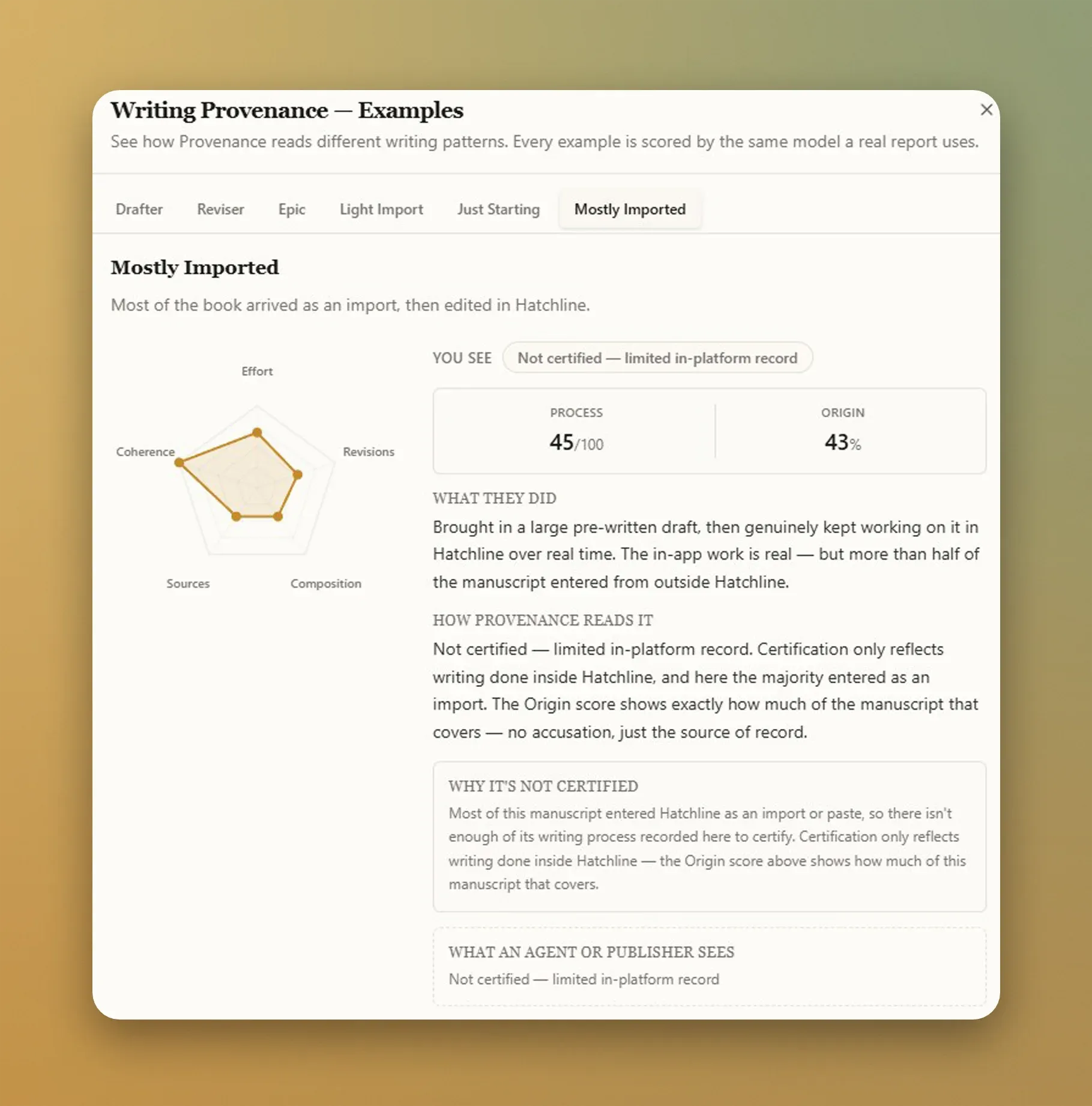
A Provenance Report is your private ledger. It is accessible only when you are ready, and only to the people you choose to share it with. It reveals the process behind your manuscript — your writing patterns, your vocabulary, your revisions, the consistency of your voice — as proof that what is yours is genuinely human-crafted.
This is not a test you have to pass, and there is no "right" way to write a novel. Every writer's process is different, so we highlight the process over the outcome. Your fingerprint is unique. The goal is not a perfect score — it is an honest, professional drafting process, which consistently earns the high marks that matter to agents and publishers.
What it would take to fool it
Writers often ask how hackable this is — not to cheat, but to know how much to trust it. Here is the honest answer.
1. Build the typist
Build an auto-typing tool that mimics human cadence, mistakes, and patterns.
2. Generate elsewhere
Use a third-party tool to generate your novel outside Hatchline.
3. Type it in, for months
Auto-type the novel across dozens of sessions over months. If our signals catch a flaw, start over.
4. Scrub the patterns
Manually clean every AI tell — vocabulary, structure, variance — consistently, across the whole manuscript. If your voice does not match, do it again.
5. Revise the whole thing
Revise the entire manuscript over dozens more sessions. Surface-level edits do not count.
Add it up, and you have made nearly holistic changes to AI-generated text. Unless you were already a highly skilled writer, the coherence falls apart — and you would have a verified report on a manuscript no one would publish. And if you are that skilled? It would take more effort to game the system than to write the book yourself. For what gain?
Why you can trust it
A moment in time
Each report captures one exact manuscript state. Change a word and you generate a new report — so a valid report can never be attached to a different, AI-written draft.
A 256-bit key
Every report is protected by a 256-bit key validated on our servers. Short of a quantum leap, no one is spoofing it.
Pulled, not passed around
Reports live in our database, not as PDFs you have to trust. Use the manuscript's unique ID to pull the report straight from Hatchline.
Ready to authenticate your work?
Start building your Provenance Report today.